
For parents · 6 min read
Riding for children: what they gain and what parents should know
Outdoor exercise, balance, calm and responsibility. What studies say about children and horses, plus safety rules that children can understand.
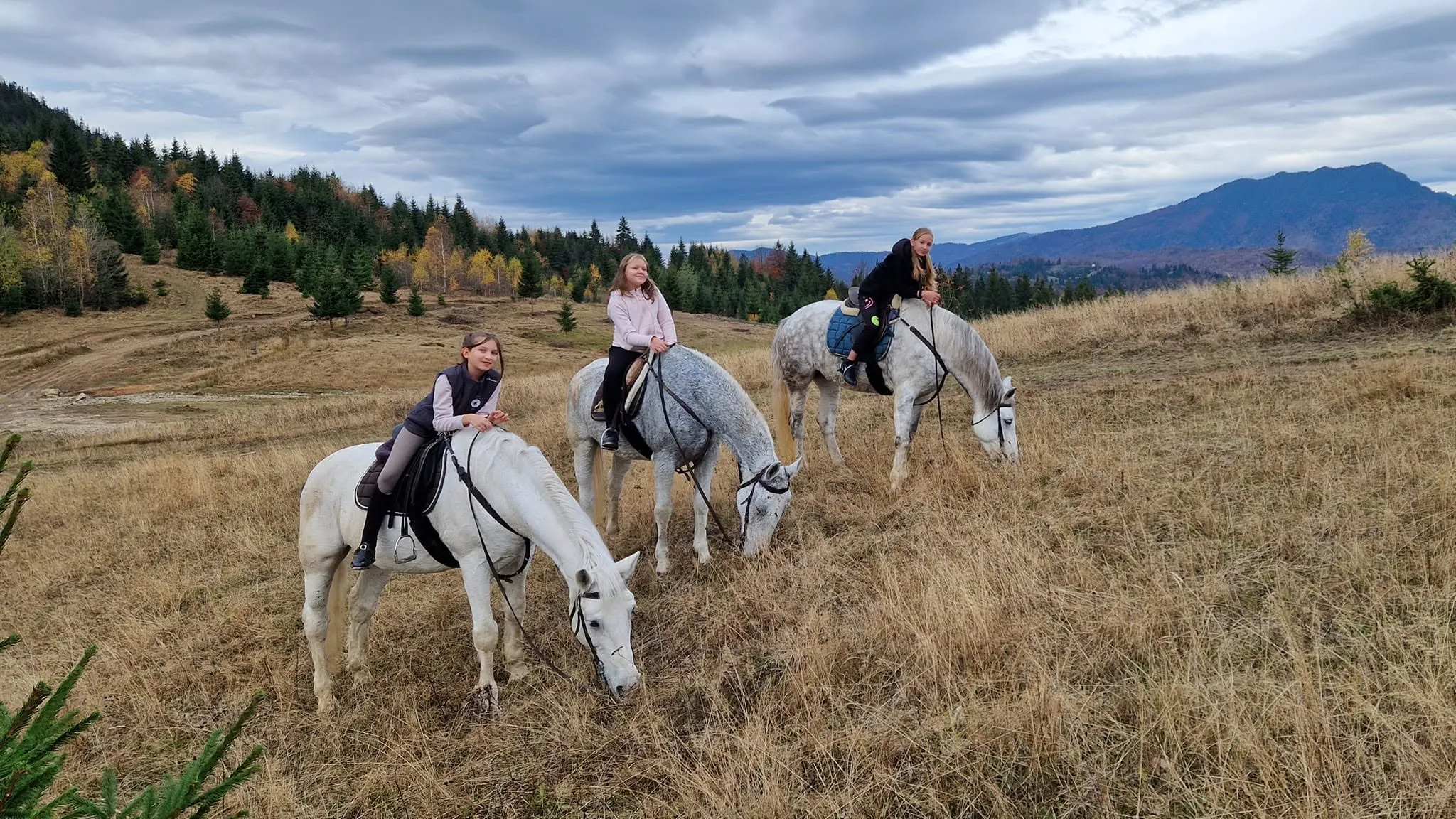
For a child, a horse is more than a weekend activity. It is a large, living animal that responds to tone of voice, to gestures and to mood. Here is what children gain, and what is good to know before the first lesson.
Real exercise, outdoors
Riding isn’t “just sitting on a horse”. The study carried out by the University of Brighton for the British Horse Society found that riding, together with the activities around horses, uses enough energy to count as moderate-intensity physical exercise. Periods of trotting increase the effort even more. And in the mountains, the “gym” comes with a view.
Balance and coordination
In the saddle, the body constantly adapts to the horse’s movement. A 2021 study (Ilić and colleagues, Baltic Journal of Health and Physical Activity) compared 58 first-grade children: 28 who rode and 30 who didn’t. The children who rode scored significantly better on overall balance, static balance and the exercises done with their eyes closed.
It is a small study comparing two groups, so on its own it doesn’t prove that riding “produces” balance. It is, however, an encouraging result.
Calm, patience and empathy
Horses are prey animals: their instinct is to move away quickly from anything that frightens them. Around a horse, children soon learn that:
- a calm voice works better than a raised one;
- slow movements are safer than sudden ones;
- an animal has needs, preferences, and better and worse days.
Horses “read” us too. A 2018 study (Proops and colleagues, Current Biology) showed that a horse that had seen a photo of an angry or a smiling person reacted differently a few hours later, when it met the actual person from the photo. For a child, it’s a lovely lesson: the way you behave matters.
Responsibility
A horse can’t be “switched off” like a tablet. It needs to be greeted, led with care and thanked at the end. Small steps, such as holding the halter correctly or offering a carrot on a flat palm, teach children that caring for another living being is serious business.
From what age?
There is no age that suits everyone. Height, balance, the ability to follow instructions and, above all, the child’s own wish all matter. When you write to us, tell us the child’s age and whether they have been on a horse before, and we’ll tell you what suits them: a first meeting with the horses, a lesson in the arena or a short ride.
Safety, in a way children understand
- A certified riding helmet at every lesson.
- Closed shoes with a small heel, and long trousers.
- No running or shouting around horses.
- We never stand right behind the horse, and we never walk under its neck.
- Carrots are offered on a flat, open palm with the fingers together, so they aren’t mistaken for the snack. The advice comes from Penn State Extension.
- An adult stays close by, and the instructor has the final word.
A young rider’s journey
On the home page we’ve put together, with our own photos, the journey from the first touch in the stable to exercises around the cones and the first trail up the mountain. See the children’s journey.
Sources
- The British Horse Society, University of Brighton (2011). The health benefits of horse riding in the UK.
- Ilić, P., Aleksić-Veljković, A., Hadžović, M. (2021). The impact of horseback riding on the balance of 7-year-old children. Baltic Journal of Health and Physical Activity, 13(3).
- Proops, L. et al. (2018). Animals remember previous facial expressions that specific humans have exhibited. Current Biology. (University of Sussex press release)
- Penn State Extension. Trick or Treat: Things to Think About When Giving Your Horse a Treat.
- Bickel, B. (2026). Building from the Ground Up: Safe Ground Handling of Horses. Penn State Extension.
Updated on 24 October 2026. This article is for information only and does not replace guidance from your instructor.
Ready for your first ride?
Instructor licensed by the Romanian Equestrian Federation. Trail rides, lessons and carriage rides in Borșa.